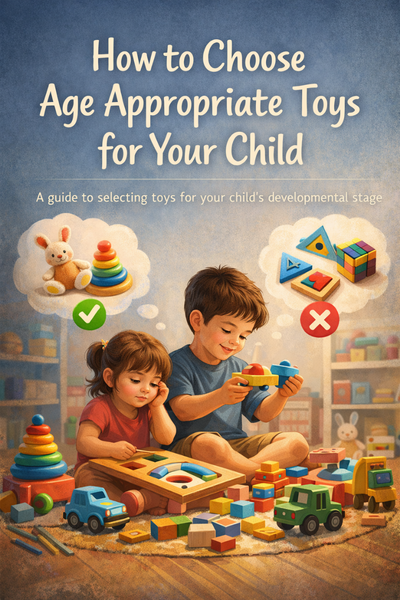
A thoughtful guide for parents on choosing age appropriate toys that support child development, improve focus, and encourage purposeful, screen free play.
I once bought a toy simply because it said “6+” on the box. My daughter was almost six, so it felt close enough. She opened it with excitement, explored it for a few minutes, and then pushed it aside.
“It’s boring,” she said.
A week later, I tried again and bought something more advanced. This toy promised to develop problem solving skills and logical thinking. She tried to figure it out, tried again, and then slowly gave up.
“It’s too hard.”
That was when I realised something important. Choosing toys is not about buying better toys. It is about choosing the right toys for a child’s developmental stage.
Why Age Appropriate Toys Matter More Than We Think
Children grow in stages, not only physically but also mentally and emotionally. What excites a three year old might feel childish to a five year old, while something designed for a six year old could overwhelm a four year old.
Age appropriate toys meet children exactly where they are in their development. They gently stretch a child’s ability while still allowing them to succeed. When this balance is right, children feel confident, curious, and motivated to explore.
However, when a toy is too easy, children lose interest quickly. When it is too difficult, frustration builds and confidence drops. Neither situation supports healthy learning or development.
Signs a Toy Is Not Age Appropriate
Sometimes the signs are obvious. A child may show frustration, abandon the toy quickly, or constantly ask for adult help.
Other times the signs are subtle. A child may play for only a few minutes before losing interest. They might say the toy is boring, or even worse, say they cannot do it.
These moments are important. Play is not just entertainment. It is how children build focus, patience, and problem solving skills.
How to Choose Age Appropriate Toys for Real Development
Choosing the right toy becomes easier when parents start asking a few simple questions.
First, consider whether the toy matches your child’s current ability, not just the age number printed on the box. Every child develops at a different pace, so age labels should be used only as general guidance.
Next, think about whether the toy encourages active thinking. The best educational toys invite children to build, imagine, solve problems, or create something new.
It is also helpful to choose toys that grow with the child. Open ended toys are especially powerful because they adapt to different developmental stages. A set of building blocks, for example, may help a younger child practice stacking while an older child uses the same blocks to design complex structures.
Finally, look for toys that support key developmental skills such as fine motor skills, logical thinking, memory, focus, creativity, and imagination. When toys naturally strengthen these skills, learning begins to feel like play rather than effort.
The Link Between Age Appropriate Toys and Attention Span
Parents often search for ways to improve their child’s focus. But attention span does not grow through lectures or instructions. It develops naturally during play.
When a toy matches a child’s developmental stage, something remarkable happens. Children stay engaged for longer periods. They try harder to solve problems and concentrate more deeply on the activity.
However, when toys are too stimulating or poorly matched to a child’s abilities, engagement becomes difficult. Over time, children may begin expecting quick rewards and constant stimulation, which can affect their ability to concentrate in school and everyday activities.
Why We Choose Differently at NOIIET
At NOIIET, age appropriate learning is not just a filter or category. It is the foundation of how we curate our toys.
Every toy is selected based on developmental readiness rather than trends. We focus on screen free, hands on educational toys that support child development at every stage.
The goal is not to impress children for a few minutes. The goal is to help them build focus, confidence, creativity, and independent thinking.
Sometimes the best gift for a child is not a bigger toy, but a better matched one. When the right toy meets the right stage of development, play becomes meaningful.
And when play becomes meaningful, learning becomes natural.